
Introduction: Choosing the Right Scanning Tool in 2025
In our increasingly digital world, the need to scan, store, and share documents efficiently has never been more important. From students and freelancers to corporate teams, choosing between a mobile solution like CamScanner and a physical flatbed scanner can significantly impact productivity. This SEO-optimized guide breaks down both options to help you make the best decision for your personal or professional needs.
What Is CamScanner?
CamScanner is one of the world’s most widely used mobile scanner apps, transforming any smartphone into a powerful scanning device. With AI enhancements, cloud sync, and OCR capabilities, it’s ideal for fast, on-the-go document scanning.
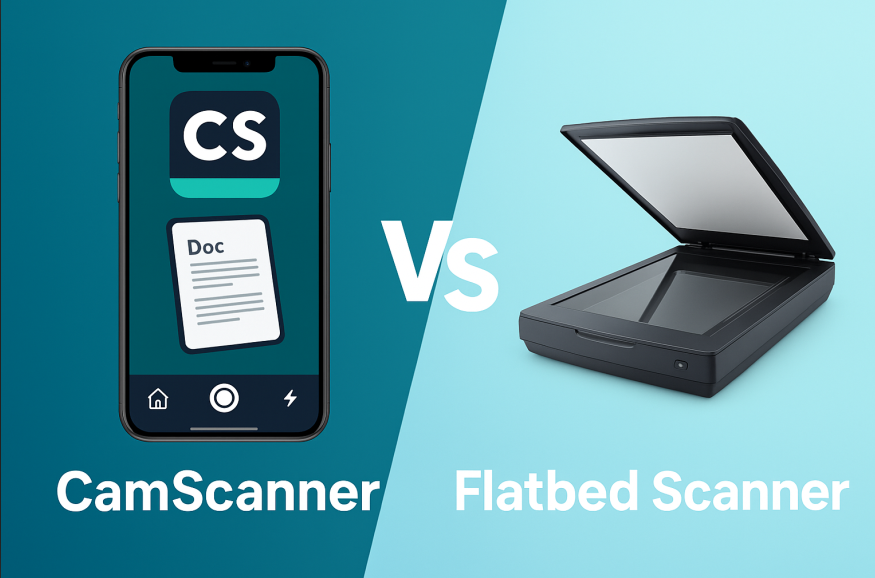
Key Features of CamScanner
- AI-powered image enhancement for clearer scans
- Smart edge detection and auto-cropping
- OCR for converting images into editable text
- Cloud integration with Google Drive, OneDrive & Dropbox
- Instant sharing via email and messaging apps
How CamScanner Works
Simply capture a photo of any document, and CamScanner automatically processes the image—enhancing clarity, removing shadows, detecting edges, and converting it into a PDF or JPG file. You can then share or save it instantly.
Ideal For: Students, freelancers, travelers, small businesses, and remote workers.
What Is a Physical Flatbed Scanner?
A flatbed scanner is a dedicated device used to produce high-resolution digital copies of documents, photos, and other materials. It offers superior quality and advanced scanning features, making it the gold standard for professional environments.
Key Features of Flatbed Scanners
- High-resolution scanning (1200 DPI or higher)
- Excellent color accuracy
- Ability to scan photos, books, negatives, and fragile items
- Durable and reliable performance
How Flatbed Scanners Work
You place a document on the glass tray, and a moving light sensor captures a precise digital image. The final result is exported to a connected computer for editing, saving, or printing.
Ideal For: Photographers, designers, offices, legal departments, and archival scanning.
Pros of Using CamScanner
1. Ultimate Portability & Convenience
Your smartphone becomes a complete scanner. Scan documents anywhere — at home, in meetings, or on the go.
2. Cost-Effective Solution
No additional hardware is required. Most essential features are available for free or at a minimal subscription cost.
3. Fast Sharing & Cloud Backup
CamScanner makes it easy to instantly share files via email, WhatsApp, or cloud platforms — a huge advantage in fast-paced digital workflows.
Cons of Using CamScanner
1. Image Quality Limitations
Despite AI filters, mobile-generated scans cannot match the resolution, color depth, or consistency of flatbed scanners.
2. Privacy & Security Concerns
Cloud-based storage can be vulnerable to data breaches. Sensitive files should be stored locally or encrypted.
3. Dependent on Phone Camera & Lighting
Low lighting or low-quality camera lenses can result in unclear or distorted scans.
Pros of Using Physical Flatbed Scanners
1. Superior Image Quality
Flatbed scanners deliver professional-grade clarity, making them ideal for photos, certificates, and detailed documents.
2. Consistent & Accurate Scans
Unlike mobile apps, flatbed scanners provide consistent output without being affected by shaky hands or lighting conditions.
3. Advanced Scanning Features
- Duplex scanning
- Film & negative scanning
- High-DPI image scanning
- Bulk document processing
Cons of Physical Flatbed Scanners
1. Lack of Portability
Flatbed scanners are bulky and designed for stationary use — not ideal for people who need mobility.
2. Higher Cost & Maintenance
Quality scanners can be costly and may require periodic maintenance.
3. Slower Workflow
Scanning involves manual setup, PC connection, and longer processing time compared to quick mobile scans.
CamScanner vs Flatbed Scanner: Comparison Table
| Feature | CamScanner | Flatbed Scanner |
| Portability | ⭐⭐⭐⭐⭐ | ⭐ |
| Image Quality | ⭐⭐ | ⭐⭐⭐⭐⭐ |
| Cost | Low | High |
| Speed | Fast | Moderate |
| Cloud Sharing | Excellent | Limited |
| Advanced Features | Basic | Extensive |
| Ideal For | Everyday scanning | Professional scanning |
Which One Should You Choose?
Choose CamScanner If You Need:
- Fast scanning on the go
- A low-cost scanning solution
- Cloud-based collaboration
- A portable everyday tool
Choose a Flatbed Scanner If You Need:
- High-resolution image scanning
- Photo and artwork scanning
- Professional document archiving
- Reliable and consistent output
Future of Scanning Technology
The scanning industry is evolving rapidly. Mobile apps like CamScanner now integrate AI for sharper text, better edge detection, and enhanced low-light performance. Meanwhile, physical scanners are becoming faster, smarter, and more compact. Hybrid scanning solutions may soon combine the best features of both formats.
Conclusion
Both CamScanner and flatbed scanners offer powerful solutions — but for different needs. If you want speed, convenience, and mobility, CamScanner is unbeatable. If you prioritize professional-grade quality and advanced features, a flatbed scanner is the better choice. Understanding your requirements will help you pick the right tool and optimize your workflow in 2025.
FAQs: CamScanner vs Flatbed Scanners
1. Can CamScanner completely replace a flatbed scanner?
Not for high-quality or professional scans. But it works well for daily tasks.
2. Is CamScanner safe for sensitive documents?
Yes, but cloud storage carries risk. Use offline mode for confidential files.
3. Are flatbed scanners compatible with smartphones?
Some models offer WiFi or Bluetooth connectivity via mobile apps.
4. Which is better for scanning photos?
Flatbed scanners offer better color accuracy and depth.